| Chapter and page # | Description/quote from novel | What impression you get about Chris with this character trait or description? | |
| Chapter 1, page 4 | “Five feet seven or eight with a wiry build, he claimed to be 24 years old and said he was from South Dakota. He explained that he wanted a ride as far as the edge of Denali National Park, where he intended to walk deep into the bush and ‘live off the land for a few month.’” | Chris is not physically fit for walking into such a dangerous environment. He seems a little crazy. | |
| Chapter 2, page 12 and 13 | Quote 1: “SOS, I NEED YOUR HELP. I AM INJURED, NEAR DEATH, AND TOO WEAK TO HIKE OUT OF HERE. I AM ALL ALONE, THIS IS NO JOKE. IN THE NAME OF GOD, PLEASE REMAIN TO SAVE ME. I AM OUT COLLECTING BERRIES CLOSE BY AND SHALL RETURN THIS EVENING. THANK YOU, CHRIS MCCANDLESS. AUGUST? Quote 2: “When they flew away, they took McCandless’s remains, a camera with five rolls of film, the SOS note, and a diary-written across the last two pages of a field guide to edible plants-that recorded the young man’s final weeks in 113 terse, enigmatic entries. | Quote 1: Chris knew that he was in great danger and was close to death. He wanted to be saved, and he was begging for help. He knew that without help, he would die. Quote 2: This quote shows that Chris McCandless did other than explore when he was in the wild. He liked to take pictures of the terrain and right about what he has been going through. It shows that McCandless really enjoyed writing also. | |
| Chapter 3, page 16 | Quote 1: “He (McCandless) used to sit right there at the end of the bar and tell us these amazing stories of his travels. He could talk for hours. A lot of folks in town got pretty attached to old Alex. Kind of strange deal what happened to him.” (Wayne Westerberg) Quote 2: “McCandless was smallish with the hard, stringy physique of an iterant laborer. There was something arresting about the youngster’s eyes. Dark and emotive, they suggested a trace of exotic blood in his heritage and conveyed vulnerability to made Westerberg want to take the kid under his wing. He had the kind of sensitive good looks that women made a big fuss over, Westerberg imagined. His face had a strange elasticity: it would be slack and expressionless one minute, only to twist suddenly into a gaping, oversize grin the distorted his features and exposed mouthful of horsy teeth. He was nearsighted and wore steel-rimmed glasses. He looked hungry. | Quote 1: Chris was always very enthusiastic about his journey and what he has been going through. He thought that everyone should hear about all of his amazing stories because he was so into the idea himself. Quote 2: Chris was a very hard worker and seemed to be very mysterious. He had multiple personalities- he was serious one minute and then smiling and happy the next. Chris was a little crazy. | |
| Chapter 4, page 29 and 31 | Quote 1: “He could simply abandon the Datsun and resume his odyssey on foot. And that’s what he decided to do. Instead of feeling distraught over this turn of events, moreover, McCandless was exhilarated: He saw the flash flood as an opportunity to shed unnecessary baggage.” Quote 2: “’He was alone,’ as James Joyce wrote of Stephen Dedalus, his artist as a young man. ‘He was unheeded, happy, and near to the wild heart of life. He was alone and young and willful and wildhearted, alone amid a waste of wild air and brackish waters and seaharvest of shells and tangle and veiled grey sunlight.” | Quote 1: Chris was fully into hitchhiking his way around the country. He must have been at least a little bit mentally unstable because no one would rather walk then drive anywhere-especially on a journey across the country. Quote 2: Chris McCandless was truly alone on this journey. He stayed with a few people at times, but he was all in this by himself. The crazy thing is, he was happy to be alone by himself on this journey. | |
| Chapter 5, page 39 and 40 | Quote 1: “In a card he mailed to Westerberg in October, he says of Bullhead, ‘It’s a good place to spend the winter and I might finally settle down and abandon my tramping life, for good. I’ll see what happens when spring comes around, because that’s when I tend to get really itchy feet.’” Quote 2: “’I don’t think he ever hung out with any of the employees after work or anything. When he talked, he was always going on about trees and nature and weird stuff like that. We all thought he was missing a few screws.’” (Lori Zarza) | Quote 1: Chris loved to keep in touch with the people that he stayed with and met over his journey, and he values friendships because he had so little. Also, Chris never likes to settle down in one place, so it was very surprising he stayed in Bullhead for so long. Quote 2: Even when Chris was in a place for a long time, he was always talking about nature and stuff that included his journey. He was very determined. He also still didn’t have much human interaction, which makes me think that he might have had a social illness. | |
| Chapter 6, page 51 | Quote 1: “He seemed very intelligent,’ Franz states in an exotic brogue that sounds like a blend of Scottish, Pennsylvanian Dutch, and Carolina drawl. ‘I thought he was too nice a kid to be living by the hot springs with those nudists and drunks and dope smokers.” (Ronald Franz) Quote 2: “An accomplished leatherworker, Franz taught Alex the secrets of his craft; for his project McCandless produced a tooled leather belt, on which he created an artful pictorial record of his wanderings.” | Quote 1: A lot of different people had different feelings about Chris. Maybe he has multiple personalities between people he seemed to like from the beginning and not so much. Quote 2: Chris seems to like to been a record of what he has been through over his journey, whether it be in a belt, pictures, his journal, or postcards to his friends that he meets. | |
| Chapter 7, page 63 and 64 | Quote 1: “Alex talked about a lot when we got together,’ Borah recalls. ‘Serious stuff, like he was baring his soul, kind of. He said he could tell me things that he couldn’t tell the others. You could see something was gnawing at him. It was pretty obvious he didn’t get along with his family, but he never said much about any of them except Carine, his little sister. He said they were pretty close. Said she was beautiful, that when she walked down the street, guys would turn their heads and stare.” (Gail Borah) Quote 2: The chill Westerberg sensed between Alex and his parents stood in marked contrast to the warmth McCandless exhibited in Carthage. Outgoing and extremely personable when the spirit moved him, he charmed a lot of folks.” | Quote 1: Chris had a rough home life, and it may have messed him up mentally. He hated talking about his family other than Carine, but the stuff he says about her is stuff that a brother wouldn’t normally say. Chris is in no sense normal. Quote 2: Chris has so many personalities from hating his family and home life, to being a weird guy talking only about plants in Bullhead, to being extremely social and friendly with the people in Carthage. It might be a level of being comfortable, but I think he has some sort of mental problems. | |
| Chapter 10 page 101 | Quote 1: Across the top of the first one (social security number), dating from McCandless’s initial visit to Carthage, in 1990, he had scrawled ‘Exempt, Exempt, Exempt, Expempt’ and given his name as Iris Fucyu. Address: ‘None of your damn busniness’. Social Security number: ‘I forget.’” Quote 2: Sam, nine years older than Chris, had seen a short article about the hiker in The Washington Post a few days earlier, but, he allows, ‘It didn’t ever occur to me that the hiker might be Chris. Never even crossed my mind. It’s ironic because when I read the article I thought ‘Oh my God, what a terrible tragedy. I feel really sorry for the family of this guy, whoever they are. What a sad story.’” | Quote 1: Chris had a smart-allic side of him which to some people was funny, others not so much. But when someone is trying to find the social security number of a dead man like McCandless, it isn’t funny. Quote 2: Sam and the rest of his family didn’t really know that much about who Chris really was. If they knew the real him, they would want to call and make sure that that wasn’t Chris as soon as they read that article. If your half-brother has been missing for month, traveling the country, I would be a little paranoid and think that it could be him. I am surprised that Sam didn’t call in earlier to make sure it wasn’t his half-brother rather than thinking, “I feel so bad for this family.” | |
| Chapter 11, page 106 and 116 | Quote 1: “It is impossible to know what murky convergence of chromosomal matter, parent-child dynamics, and alignment of the cosmos was responsible, but Christopher Johnson McCandless came into the world with unusual gifts and a will not easily deflected from its trajectory. At the age of two, he got up in the middle of the night, found his way outside without waking his parents, and entered a house down the street to plunder a neighbor’s candy drawer.” Quote 2: “When I mentioned the offer to Chris,’ says Walt. ‘he wouldn’t even consider it. He told his boss that he had other plans.’ As soon as high school was over, Chris declared, he was going to get behind the wheel of his new car and spend the summer driving across the country.” | Quote 1: Ever since Chris was born, he had some sort of entitlement and freedom within himself which is very strange for a young person to have. Being able to do what he did at two years old is unnatural because some kids can’t even walk that well at the age of two. Quote 2: As Chris grew up, his sense of entitlement only grew stronger. | |
| Chapter 12, page 118 and 119 | Quote 1: “Near the end of his trip, it turned out, Chris had gotten lost in the Mojave Desert and had nearly succumbed to dehydration. His parents were extremely alarmed when they heard about this brush with disaster but were unsure how to persuade Chris to exercise more caution in the future. ‘Chris was good at almost everything he tried,’ Walt reflects, ‘which made him supremely overconfident. If you attempted to talk him out of something, he wouldn’t argue. He’d just nod politely and then do exactly what he wanted.’” Quote 2: “Chris,’ says Billie, ‘thought we were idiots for worrying about him.’” | Quote 1: Chris’s bad quality of being overconfident led him to many problems, in this case, almost dehydration. This trait also led him to more problems over his journey which may have led to his death, being overconfident that he would get the food or cross the river or even make it somewhere. Quote 2: Chris’s parents always tried to be good parents and talk him out of stuff that would harm him, but being as stubborn as he was, he wouldn’t even listen to them and then he would mock them. If he would have listened to his parents smart ideas, he could still be alive. | |
| Chapter 13, page 129 | Quote 1: “Like Chris, Carine is energetic and self-assured, a high achiever, quick to state and opinion. Also like Chris, she clashed fiercely with Walt and Billie as an adolescent. But the differences between the siblings were greater than their similarities.” Quote 2: “Ten months after Chris’s death, Carine still grieves deeply for her brother. ‘I can’t seem to get through a day without crying,’ she says with a look of puzzlement. ‘For some reason the worst is when I am in the car by myself. Not once have I been able to make a twenty minute drive from home to the shop without thinking about Chris and breaking down. I get over it, but when it happens, it’s hard.” | Quote 1: Chris got along so well with his sister Carine because they did have a lot in common and they both had some great qualities. But the major difference between Chris and Carine is that Carine never did anything to really hurt or scare their parents as bad at Chris did over his years, like packing up and taking on journey without them knowing. Quote 2: Chris and Carine were so close when they were young up until the day that he left. It was so hard for Carine to deal with the pain of him not being there anymore. Putting that kind of pain on someone you love is not right. Chris’s mental problems must have had something to do with that too, because you just don’t leave your sister especially if you were so close. | |
| Chapter 16, page 159 and 163 | Quote 1: “Alex was clean shaven and had short hair, and I could tell by the way language he used that he was a real sharp fella. He wasn’t what you’d call a typical hitchhiker. I’m usually leery of ‘em. I figure there’s probably something wrong with a guy if he can’t even afford a bus ticket.” (Stuckey) Quote 2: “Two years he walks the earth, no phone, no pool, no pets, no cigarettes. Ultimate freedom. An extremist. An aesthetic voyager whose home is the road. Escaped from Atlanta, thou shalt not return, ‘cause “the west is the best.” And now after two rambling years comes the final and greatest adventure. The climactic battle to kill the false being within and victoriously conclude the spiritual revolution. Ten days and nights of freight trains and hitchhiking bring him to the great white north. No longer to be poisoned by civilization he flees, and walks upon the land to become lost in the wild.” –Alexander Supertramp May 1992 | Quote 1: Chris again has a different personality. He is very open with this guy, and that only seems to happen with people that he really cares about. It is hard to keep a grasp of what his personality is going to be with every person he meets. Quote 2: This piece of writing that Chris wrote shows you how into writing that he really was and that he was very good at it. It also shows you how crazy he really is talking about how he wants to conclude the spiritual revelation within himself? He thinks that being part of a journey to Alaska will change who he is, but in reality, all he truly does is eat, write, and then die. | |
| Chapter 17, pages 174 and 179 | Quote 1: “In coming to Alaska, McCandless yearned to wander uncharted country, to find a blank spot on the map. In 1992, however, there were no more blank spots on the map- not in Alaska, not anywhere. But Chris, with his idiosyncratic logic, came up with an elegant solution to this dilemma: He simply got rid of the map. In his own mind, if nowhere else, the terra would thereby remain incognita. Quote 2: “It is a bear skull, the remains of a grizzly shot by someone who visited the bus years before McCandless’s tenure. A message scratched in Chris’s tidy hand brackets a cranial bullet hole: ‘All hail the phantom bear, the beast within us all.’ Alexander Supertramp May 1992.” | Quote 1: Chris had very different ways of thinking, and being the stubborn person that he was, he got his way. He was looking for a blank spot, he would ditch the map and since he had never been to the Stampede Trail before, it was all a blank spot. This was a very unique way of thinking. Quote 2: Chris was going completely insane on his final journey on the Stampede Trail. | |
| Chapter 18, pages 189 and 199 | Quote 1: He (McCandless) noted, ‘HAPPINESS IS ONLY REAL WHEN SHARED.’” Quote 2: “On the other side of the page, which was blank, McCandless penned a brief adios: “I HAVE HAD A HAPPY LIFE AND THANK THE LORD. GOODBYE AND MAY GOD BLESS US ALL!’” | Quote 1: Chris was finally coming to his senses that living in the wilderness is not going to make you a better person. Being alone in the wilderness will make you crazy. Quote 2: He knew that he was going to die soon because of how insanely weak he was, so it was smart of him to write his last feelings down, so people would know how he felt when he died. | |
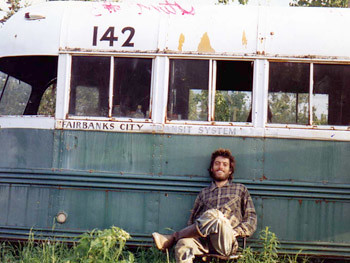 |
| Chris McCandless from the movie |
http://farm3.static.flickr.com/2129/2100029996_6dd821dc8c.jpg

No comments:
Post a Comment